
More from Smartview360
Ecosystem
Technology
Integration
Partner
Login →
DE
For Brands
Why Smartview360
Who is Smartview360
Insights
IT Leasing
Contact
DE | EN
More from Smartview360
Smartview360 runs the wholesale business of fashion and lifestyle brands across Europe — from the showroom through the warehouse to the ERP. Behind it stands a platform we have developed, refined and re-architected ourselves over more than a decade: one API, three native clients, 34 ERP integrations. All in-house.
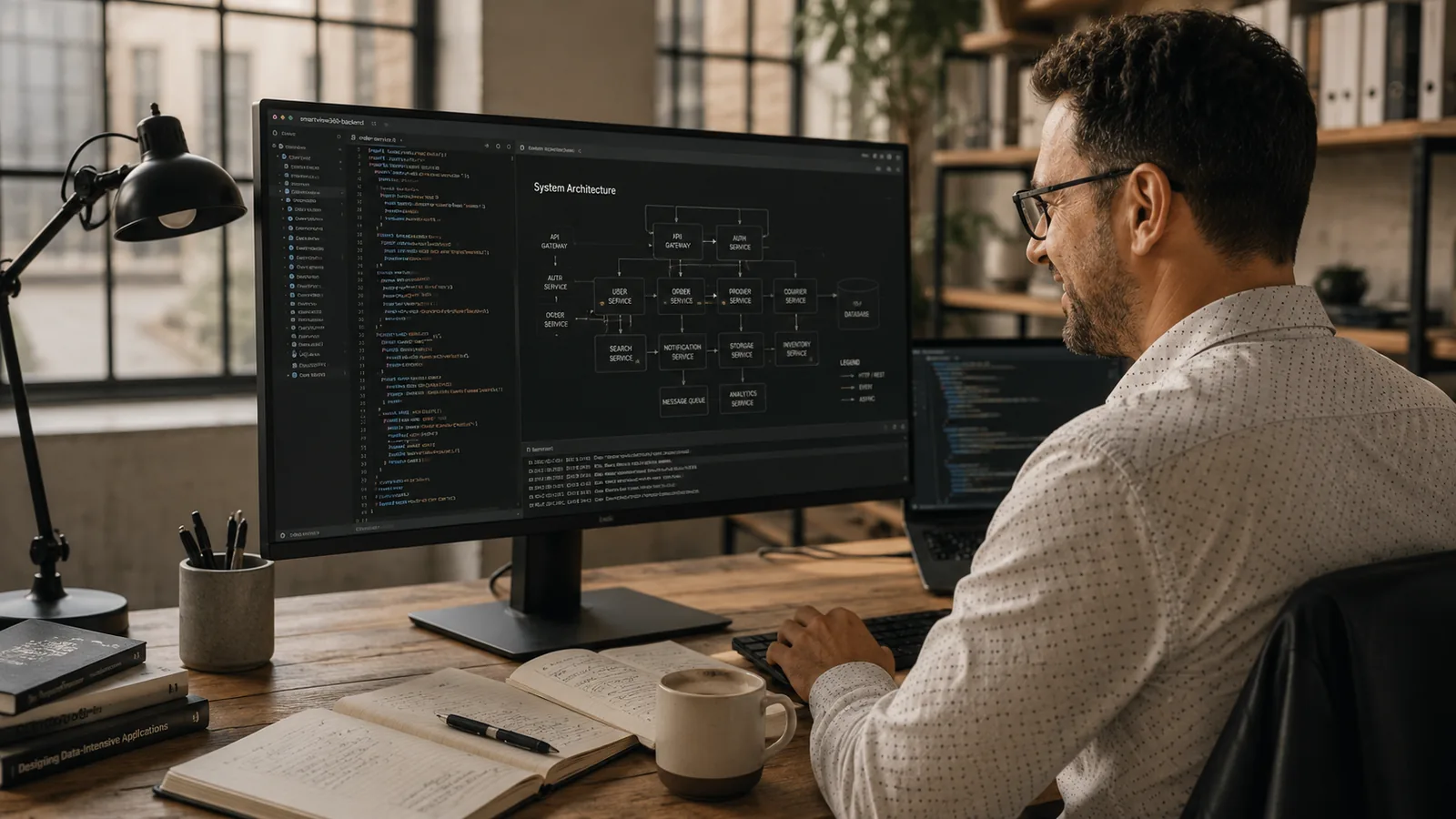
A B2B order doesn’t live in one place. It starts on an iPad in a showroom with no Wi-Fi, gets reworked in the browser by a back-office colleague, and lands synchronised in the brand’s ERP. We built for all three at once — a single, versioned REST API as the source of truth.
Which systems we connect and what that means for your sales → Integration
Every client — web and native iPad alike — authenticates the same way, works on the same entities and inherits the same permissions. This discipline is why an order created on the iPad and one created in the browser are the same order — under the same rules.
Our API is a service-oriented backend built with domain-driven design — 28 business domains, each with its own logic, behind a hardened authentication and middleware layer. Not a generic shop engine bent into fashion shape — but modelled directly on how brands actually sell: seasons, pre-orders, delivery windows, customer-specific price lists, size/width matrices and end-to-end tenant isolation per brand.
This is where most platforms stop, and where we begin. We run 34 production ERP integrations — Martini, Intex, DataForce, Eagle Creek and many more — via a clean adapter architecture in which every provider is a clearly defined contract rather than a one-off hack.
Brands don’t change their back office to work with us. We meet each of their systems on its own terms. This breadth is years of accumulated, hard-won domain knowledge that a newcomer simply cannot replicate.
Showrooms have poor Wi-Fi. Trade fairs are worse. That’s why our iPadOS app — native in Swift, UIKit + SwiftUI — is built offline-first on Core Data, with a delta-sync engine using entity hash tracking that transfers only what changed.
The result: an agent writes a complete order with no connection at all and can trust that it reconciles perfectly on reconnect. On top, the app delivers what only native can — on-device PDF generation, barcode and QR scanning, and Live Activities for download tracking. The data model alone has evolved across 31+ migration versions without ever losing local customer data.
Our web platform is a single-page app that serves ORDERBOOK and MEDIABOOK from one codebase: dashboards with live analytics, an AI image-generation studio with a credit system, an in-browser image editor with full version history and rollback, and B2B networking.
We’ve done this migration before — from an earlier Angular generation. That’s exactly why we know how to modernise a production platform without downtime for the brands that depend on it.
We write the Swift, the Vue and the Laravel. There is no integration seam that isn’t ours and that we can’t fix.
34 ERP integrations are a decade of domain knowledge cast into software.
Seasons, delivery windows, price lists, size matrices, pre-orders — modelled correctly because we’ve lived the edge cases ourselves.
We modernise live platforms that brands run their revenue on — and they stay online.
We’ll happily walk you through the architecture in detail — as equals, engineer to engineer.
To the platform →